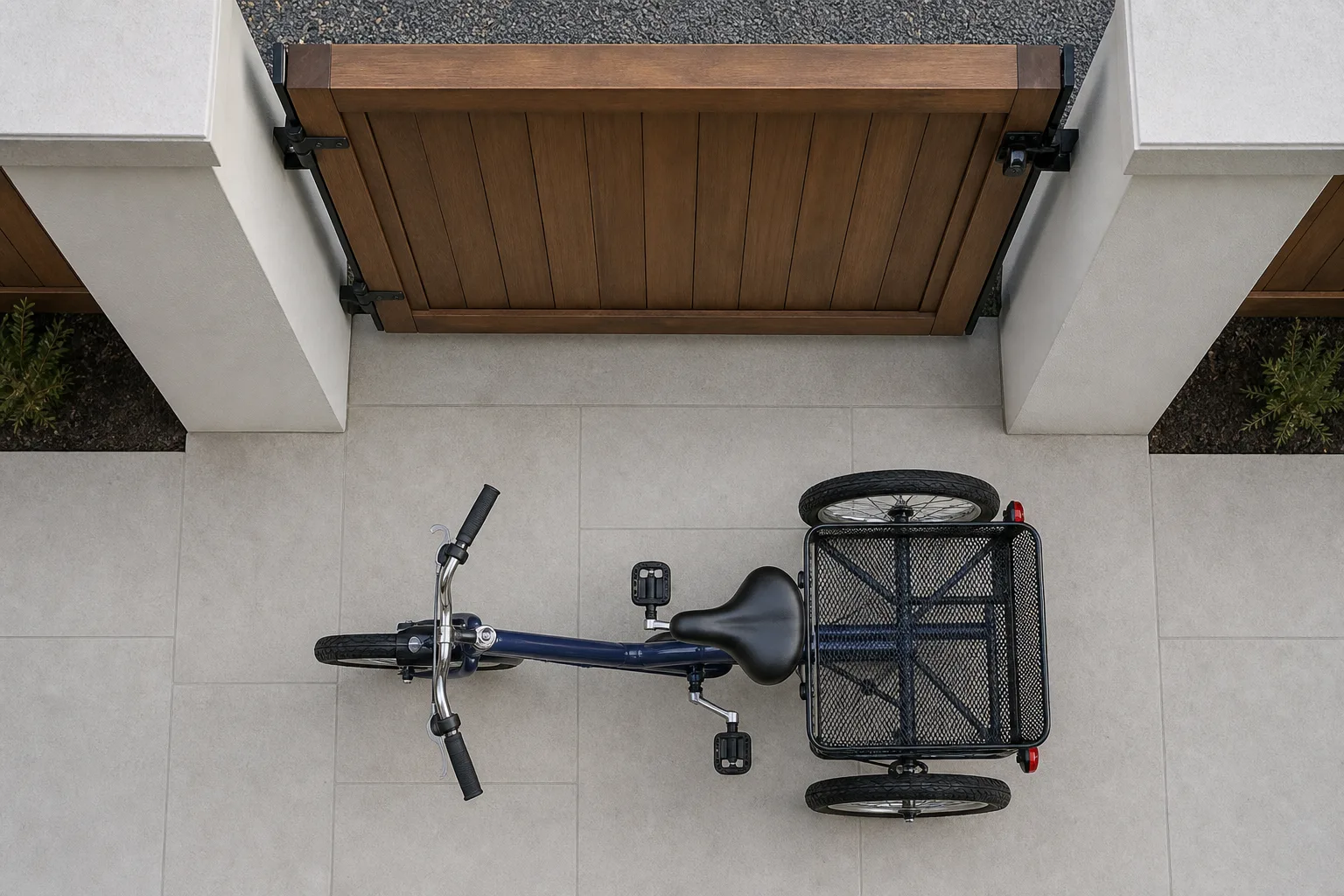
A buyer in a row house with a shared side yard measured her gate at thirty inches clear, ordered a delta e-trike listed at thirty-two inches wide, and reasoned that the two extra inches would give somewhere in the tilt of the frame. They did not. The rear axle on a delta trike is rigid, the track is fixed, and the wheels arrive at the gate posts at the same instant. She kept the trike, removed the gate, and rehung it to swing outward on a wider opening, which cost a Saturday and a bag of hardware. The measurement she needed was not on the spec sheet in the form she needed it.
1. Measure the narrowest point on the route, not the doorway
Published track width is the distance between the outer faces of the rear tires, and it is usually honest, but it is not the number that stops you. What stops you is the gate post with a latch bolt protruding, the basement stair with a handrail, the elevator door with a rubber bumper, the storage cage with a padlock hasp. Walk the whole route with a tape measure and write down the smallest clear opening, then subtract an inch for the fact that you will be pushing the trike at a slight angle. Compare that figure, not the doorway figure, against track width.
2. Check whether the fenders and pedals are wider than the wheels
On several delta designs, the widest point is not the tire at all. Rear fender stays, a basket that overhangs the frame, a chainguard, or the outboard end of a pedal at its farthest swing can each push the real envelope past the quoted track. A careful reader asks the seller for the width at the fenders and the width at the basket separately, and if the answer is vague, measures a floor model. Pedals can be folded or removed. Baskets can be swapped. Fender stays are usually the one dimension you cannot quietly negotiate away.
3. Know the weight you can actually lift, not the weight listed
A pedal-only adult trike sits in a range that a fit adult can wrestle; an electric one with a rear hub motor, a steel frame, and a battery adds a substantial amount, and almost all of that addition sits behind the seat. That matters more than the total. Lifting a trike onto anything means lifting one end at a time, and the rear end is where the axle, the differential, the motor, and often the battery live. Weigh the rear by lifting it onto a bathroom scale before you commit to any carrying plan that involves your own back.
4. Accept that most car racks are not built for three wheels
Trunk-mounted racks and hanging hitch racks assume a single top tube and two wheels in line, and a trike offers neither. Platform hitch racks come closer, but the tray length and the tie-down arms are sized for a bicycle wheelbase, and the rear track is far wider than the tray. In practice, people who move trikes regularly use a cargo trailer, a van or pickup with a ramp, or a folding trike that collapses to something a hatchback will swallow. Confirm the folded dimensions against your actual trunk, with the seats down and the parcel shelf out, before the trike arrives.
5. Ask who will service the rear end
Two-wheel shops are comfortable with front brakes, derailleurs, and wheels. A trike adds a parking brake with a locking lever, a long cable run from the bars to the rear axle, and either a live axle with a differential or a single driven wheel with a freewheel on the other side. Cables at that length stretch, and adjustment drifts, so the parking brake that held on a slope in March may not hold in September. The Consumer Product Safety Commission is responsible for federal bicycle requirements, and parking brake behavior is exactly the kind of function worth testing on the hill you actually park on. Call two local shops and ask, plainly, whether they have worked on a trike before.
The buyer with the rehung gate now stores her trike inside the yard, charges it there, and rides it four days a week to a grocery store eight blocks away. Everything she had to solve was solvable. All of it would have been cheaper to solve with a tape measure and three phone calls made in the week before the order went in.